The JailerEspañol

ENTERING THE STORY

What lies on the other side

ARCANAS LETANÍAS · NAMES FROM THE MARGINS

Their appearance belongs
to another universe.

Murdogs, Hedomogs and Demorgs exist on other planes of the story. Their bodies, shells and seemingly fantastical features make visible a nature that does not belong to human organic life.

Perception also plays a part: a consciousness translates what it encounters through memory, culture and its own limits. A form can therefore be both true and partial. The man in the hat is a translation, not a complete explanation of his nature.

01

Murdogs

Loosening the knot.

Consciousnesses that have released the chains of attachment that bound them to eternal return. Their shell shields them from new attachments without making them immune; they cross the realm of the HEDOMOGS and the valley of the DEMORGS toward the threshold where the self ends.

Explore these figures ↗
02

Hedomogs

Making the production desirable.

Every religion and everything sold to you as goodness. They create beauty, spirituality and the promise of a better life; once a consciousness interprets them, they become prophets. They never attack the MURDOG: they seduce it with a purpose that can chain it to the wheel again.

Explore these figures ↗
03

Demorgs

Envy of the creator’s gaze.

The demons of every religion. Believing humans are the creator’s favorites, they envy the attention he gives them and torment consciousnesses bound to human bodies. They hunt the MURDOG as a trophy, to drag it back to the purgatory of the wheel.

Explore these figures ↗

The DOOMERS live apart: abandoned experiments survive on the man in the hat’s sap there. Their struggle is distinct from that of the DEMORGS of the valley. Read the MURDOGS comic ↗

How this universe works

Human life occupies the center of the man in the hat’s production, but it does not exhaust existence. There is a transit enclosure and a margin inhabited by forms with different functions. These names provide bearings; they do not all mean the same thing.

NamePlace or function
The man in the hatThe creator of this production. Makes, observes, reassembles and returns forms to repetition.
Organic lifeThe central stage: bodies, desire, family, fear, history and the need to continue.
DOMETied to the function, its perceptible presence and the architecture of the boundary. The dome itself is the enclosure that contains the known universe.
DOMThe one who executes the function: it administers the boundary and cuts weakened chains so the consciousness re-chains and stays useful to the man in the hat.
DOMOGSThe broader plane of the margins around the dome. Murdogs, Demorgs, Hedomogs and other forms belong here.

The city is the first layer: Earth inside the universe and its dome; the dome inside the Domogs realm, enclosed in another sphere observed by the man in the hat. The dream realm’s placement remains open.

What is a demiurge? Is the man in the hat one?

A demiurge is a craftsman of the cosmos: a figure that constructs or orders a world. In Plato’s Timaeus, this craftsman is benevolent and brings order to preexisting chaos. The word itself therefore does not mean “evil god.”

The Jailer uses it to raise a different possibility: the man in the hat may be the maker of our reality without being the absolute origin of everything. Nerio does not know whether he is looking at the workshop’s owner or the administrator of one room inside a larger workshop.

God, Demon and Demiurge are the three shadows the novel brings together in the man in the hat: creator for someone seeking a father, a moral shadow for someone witnessing suffering, and craftsman for someone suspecting a manufactured reality. This is a literary construction of the name.

Philosophical context: Plato’s Timaeus ↗

Novel · chapters 39

Why does the man in the hat keep the production moving?

The man in the hat observes the sphere containing his creations. His glasses express a non-organic connection: like sap linking roots and branches, they let him perceive what happens within them. Creation distracts him from boredom and gives his existence meaning; it does not feed him energy, nor is evil his purpose.

The novel proposes that the man in the hat creates, tests, mixes, discards and watches. What holds his attention is the scene: creatures desiring, suffering, loving, contradicting themselves and trying again. There is no promise that this process is meant to make them better.

The “force of existence” is the drive the man in the hat sowed in his creatures so that biology never stops: survival and reproduction. In human life it also appears as hunger, ambition, legacy and the need to preserve an identity. It belongs to the novel’s cosmology, not to established physics.

A creature experiences these impulses from within and describes them as its own decisions. That is where the conflict begins: the will may be narrating the movement of the machinery sustaining it.

Novel · chapters 39 and 41
How does a consciousness become a Murdog?

In Nerio’s account, it reaches the margins after releasing the chains of attachment that held it to the wheel. Fear, desire, debt, wounds, causes and the need to remain someone no longer hold it with the same force.

It may come from humanity or from another conscious species. The novel leaves that origin open. It describes neither a transformation ceremony nor a reward for good conduct, but a consciousness exhausted by producing the noise the production expected.

The quiet it seeks is an absence of images, demands and identity, compared in the novel to the deepest sleep without a witness. It is neither a dramatic death nor a technique to carry out. As long as it still exists, a chain can be reactivated: love, anger or nostalgia can hook it again and return it to the wheel.

Novel · chapters 38–39 and 41

Why do some Murdogs remain active?

Some remain at the margins and intervene near other exhausted consciousnesses. They offer signals or small pressures that help those beings recognize the anchors still holding them. Their visual functions—loosening an attachment, untying a passion or watching a return—give shape to that work.

Help does not guarantee release, and the decision to let go belongs to the other consciousness. Helping also exposes the Murdog: any affection felt inside another’s bunker (love, anger, nostalgia, sorrow) can chain it again. Valten is the function that watches that a Murdog does not return to life. Nerio does not know whether the man in the hat tolerates these interventions, barely notices them or finds a way to exploit them.

The shells and ladybug-inspired anatomy belong to their design as beings on another plane. Each figure retains its own identity; visual resemblance does not make the entities interchangeable.

Novel · chapters 39 and 41

Why do the Demorgs exist?

The Demorgs are the demons of every religion. They belong to the man in the hat’s creation, but they are not his discards: those are the Doomers, who live apart. The Demorgs act from a dominant force: envy, contempt or resentment.

They resent humans because humans occupy the stage’s spotlight. They believe humans are the man in the hat’s favorites and envy the attention he gives them, although that attention is not love: humans only entertain him. Like the envious, they do not mind remaining in their own misery as long as the other is not better off.

Their pressure produces terror, anxiety, nightmares and disturbances in human experience. With the Murdog they go further: they hunt it as a trophy, because it embodies the ideal of no longer suffering, and try to subdue it and drag it back to the purgatory of the wheel.

Novel · chapters 39

How can beauty become a chain?

Hedomogs are every religion and everything sold to you as goodness. They produce beauty (music, color, faces, gardens, temples and oases) and also spirituality and the promise of a better life than the one suffered in biological experience. When a consciousness interprets them, they become prophets and the figures of each religion. The pleasure can be real; precisely because something is beautiful, a creature can want to possess it, fear losing it or measure its life against it.

Capture grows deeper when beauty takes the form of a paradise that must be deserved. The creature obeys, corrects itself and makes sacrifices, yet another condition always appears. The prize keeps shining and the creature keeps feeling inadequate.

Hedomogs never attack: they seduce. This is how happiness can be sold to maintain attachment. Beauty adds contrast to the production: it allows creatures to remember loss, compare the present and turn a fall into tragedy.

Novel · chapters 39

How do the margins connect with our world?

The boundary between organic life and what surrounds it is not portrayed as completely sealed. DOME is tied to the architecture of the boundary; DOM is the one who executes the function there, where contact or intervention is possible. Active Murdogs can act from those margins.

The signals, dreams and correspondences in the novel bring Sophia, Eli and Thomas toward this frontier. The audiovisual continuity expands that connection: beings from other planes can enter other universes and access the bunkers of consciousnesses. Aurora’s devices develop a route for contact from human experience.

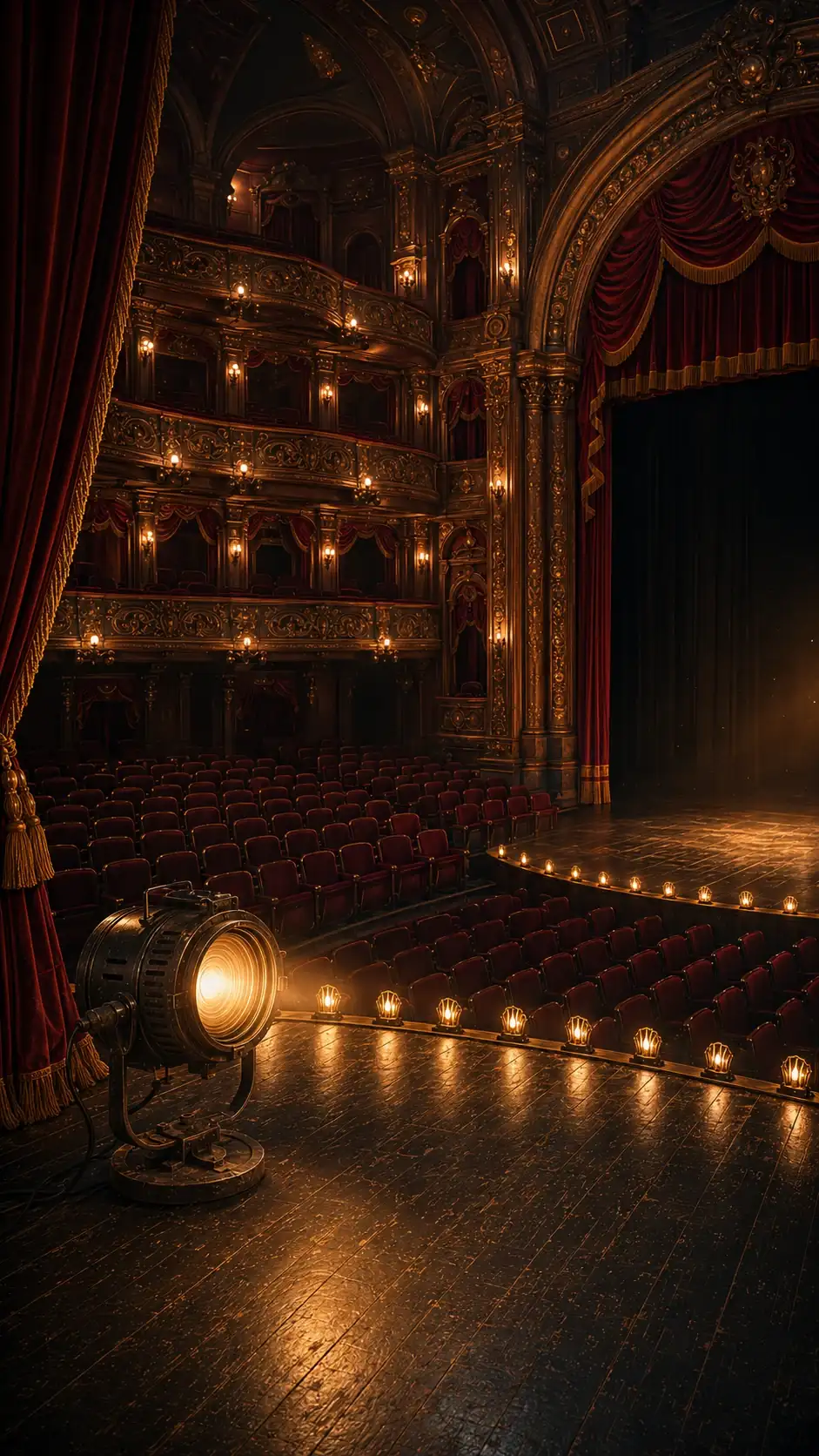
El Umbral theater brings the same image into the city: on one side is the visible performance; behind it is the stage machinery that makes it possible.

Novel · chapters 18, 37 and 39; audiovisual continuity

How does a bunker differ from a bubble?

The bunker is the structure of the self: the post from which a consciousness looks, desires, judges and defends itself. Its walls are built from the body, memory, fear, relationships, beliefs and the need to preserve a name.

The bubble is the field of perception that this structure builds around itself. Everything arriving from outside passes through its filters. The creature receives part of the world and can mistake that part for the whole of reality.

For example, two people hear “we need to talk.” One hears an invitation; the other, a threat. The words are identical, but each bunker receives them through a different history. This example illustrates the mechanism Nerio describes.

Novel · chapters 36 and 38

Where does religion fit within the five prisons?

Religion is explicitly included in the prison of morality. Doctrine, commandment, purity and judgment organize what is permitted and forbidden; sin, guilt and punishment internalize surveillance. Religious authority presents obedience as duty and salvation as a promise.

It also operates within the prison of the self: soul, transcendence and permanence answer the desire for one’s identity not to disappear. The same religion can sustain moral obedience and hope for personal continuity.

The novel therefore retains five prisons. Religion is neither omitted within an abstract category nor made into a sixth prison: it operates through mechanisms already present in morality and the self. Chapter 22 states this dual relationship, which chapters 39 and 40 develop.

Novel · chapters 22, 38–40

Are the layers levels of superiority?

Nerio describes them as regions of affinity. Bubbles settle near what resonates with their composition: fears, desires, wounds, habits and ways of interpreting experience.

That composition changes. A loss, a relationship, a humiliation or aging can change what a consciousness lets in and where it finds affinity. Such movement does not automatically mean rising, improving or becoming free.

The images of tar, oil, water, wasteland and vapor give visual form to different environments around the bunkers. They are not the self’s five prisons: those describe ways of holding a consciousness, not materials in the landscape.

Novel · chapters 38; environments from the adaptation

What keeps the return going?

Return depends on chains, not on keeping a form. A debt, a cause, a desire, fear of disappearing or the need to be someone again are points of attachment: the wheel finds a hold there and resumes the creature’s participation in the production.

Recognizing the mechanism does not remove its anchors. Someone can turn insight into prestige, denunciation into superiority or the wish for freedom into a new identity to defend.

The novel examines this return without making it a reliable escape procedure. Knowing how to describe a door does not mean having crossed its boundary.

Novel · chapters 37–39

Why are we jailers too?

The bunker’s structure repeats at other scales: couples, families, classrooms, institutions and states. Someone can impose their fear as protection, their debt as love or their taste as a rule everyone else must follow.

This is the social fractal: the stage changes size, but control, justification and the defense of one’s importance recur. The comparison describes a mechanism; it does not claim that every action causes the same harm.

Thomas must examine what he did within those relationships, as well as expose Victor Vale’s machinery. The spotlight can no longer point exclusively at the bunker across from his own.

Novel · chapters 38 and 40

Does Nerio have the final explanation?

No. Nerio works with fragments, drawings, experiences and conjectures. His notebook helps him notice patterns, but he knows that treating it as absolute truth would build another bunker.

He understands part of the stage machinery and also enjoys the performance. He is involved in the same dynamics he describes. His remaining doubts are part of his character, not gaps to fill with supposed omniscience.

Novel · chapters 36–42

The stage and backstage machinery of El Umbral theater
El Umbral · a setting from the adaptation

ONE WORD, TWO SCALES

Why
El Umbral?

El Umbral is a theater. Nerio works among its lights and scenery. Encounters, operations and conversations converge there, revealing how much a scene depends on what remains hidden behind it.

Umbral also means threshold. It is the boundary where what a consciousness considers its reality begins to contact another plane. The same image connects the passage from audience to stage with movement between forms of existence.

DOME
The presence and architecture of the boundary, tied to the function. The dome is the enclosure of the known universe.
DOM
The one who executes the function: it cuts weakened chains so the consciousness re-chains and stays useful to the man in the hat.
DOMOGS
The outer plane of the margins around the dome. It is not a single species.

Novel · chapters 27, 37 and 39

THE ROOM FROM WHICH WE LOOK

The Bunker

Consciousness learns to call its bunker home.

The bunker is the structure of the self. A consciousness looks out from a post built from the body, memory, fear, desires, relationships and beliefs. That structure also organizes how it listens and judges.

The bubble around it is its field of perception: the part of the world it can receive through those filters. The adaptation makes that architecture visible through bunkers, chains, rooms and conduits accessible from another plane.

Novel · chapters 36–38 and 42

Understand the bunker and the bubble ↑
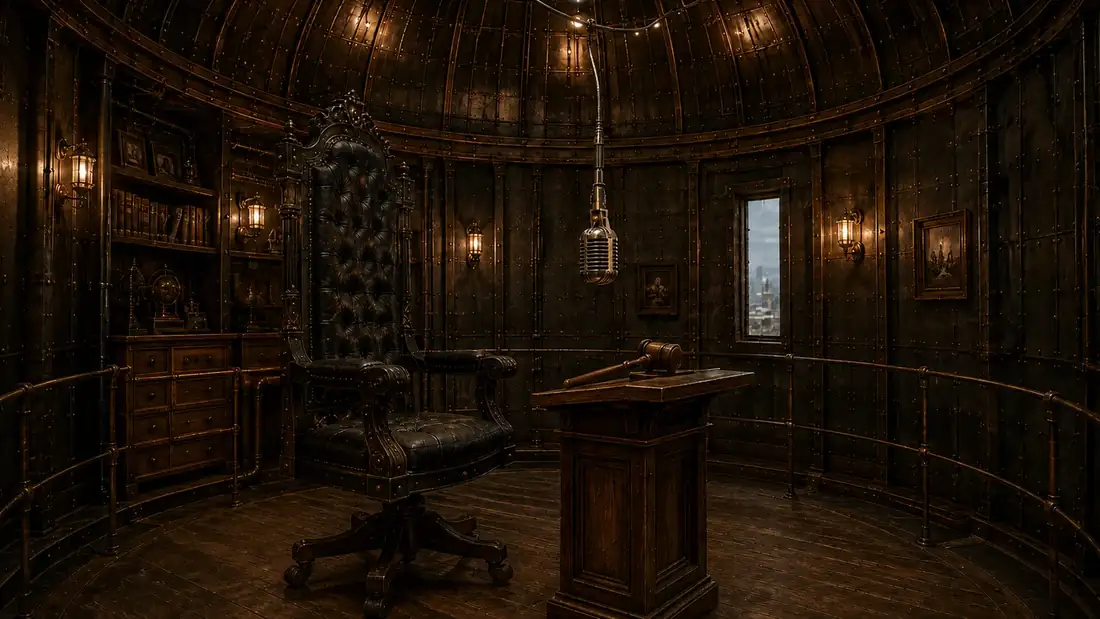
The interior of a bunker, with instruments, a seat and enclosing walls
FROM WITHIN

Each consciousness organizes a world from what it has kept in its own room.

The spotlight

The gaze directed outward. It illuminates another’s failing while leaving its operator in shadow.

The loudspeaker

The voice of the self: explaining, justifying and demanding that its experience matter.

The gavel

The inner judge. It passes sentence and turns its own perspective into a court.

The conduits

Words, looks and signals traveling between consciousnesses. Each receives them through its own history.

FIVE PRISONS · TWENTY-FIVE CHAINS

The floors of confinement

Recognizing a chain does not mean having released it.

The notebook groups five anchors under each prison. They organize the mechanism rather than provide a fixed checklist for judging other people.

Religion operates through morality and the self’s claim to permanence. These are two mechanisms within the five prisons, not an additional prison.

Where does religion fit? ↗

Novel · chapters 22, 38–40

  1. 01

    The body

    Hunger · sex · pain · illness · survival.

  2. 02

    Memory

    Trauma · nostalgia · shame · resentment · repair.

  3. 03

    Belonging

    Blood ties · family name · family guilt · loyalty · abandonment.

  4. 04

    Morality and religion

    Virtue · guilt · punishment · flag · tribunal.

    Religion belongs within this prison: doctrine, commandment, purity, sin, guilt and judgment. Sacred authority and the promise of salvation can turn obedience into an inner obligation.

  5. 05

    The self

    Reputation · one’s work · recognition · power · permanence.

    Religion also reaches into the self through promises of soul, transcendence and permanence: the desire for our identity to survive the disappearance of the body.